Anxiety in children
When your child seems constantly worried — and you can't find a reason to explain it
You reassure them. You talk it through. But the worry always comes back. And slowly, it starts shaping what they will and won't do — until anxiety is running the household.
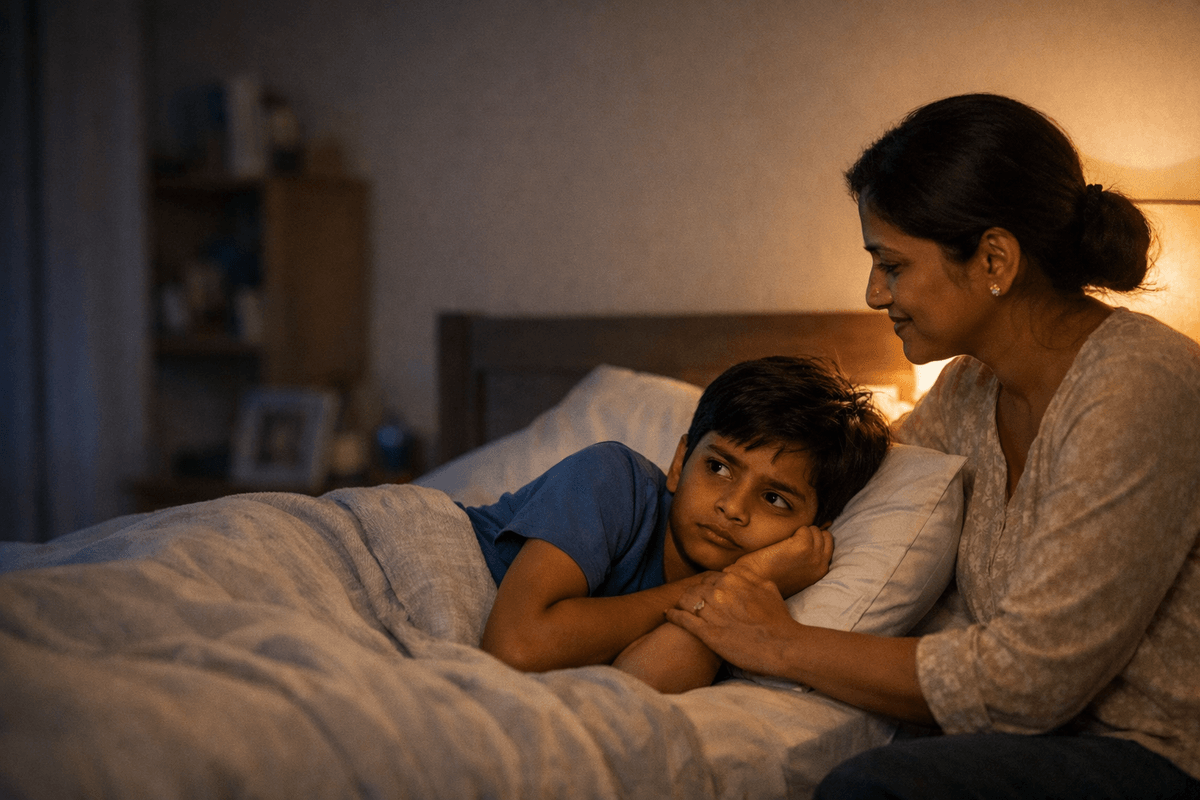
Recognition
Does This Feel Like You?
If any of the following sound familiar, you are not alone — and you have come to the right place.
Your child worries about things most children their age don't seem to notice — school, friendships, health, what might go wrong
Bedtime has become the hardest part of the day — they can't switch off, and sleep is difficult or impossible
They avoid situations that make them anxious — parties, school events, trying anything new — and the list of avoided things keeps growing
Stomach aches, headaches, or other physical complaints that doctors can't find a medical cause for
They need constant reassurance — asking "will it be okay?" over and over, and never quite believing the answer
School has become a daily battle — either because of the anxiety itself, or because they are actively refusing to go
They fall apart when plans change unexpectedly, or when anything new or uncertain is on the horizon
As a parent, you feel helpless — everything you do to calm them only works briefly, and you are exhausted
Understanding
What Anxiety in children Actually Is
Anxiety is the most common mental health condition in childhood, and one of the most treatable. It is the brain's threat-detection system working in overdrive — signalling danger in situations that are not actually dangerous, or treating manageable situations as if they were overwhelming.
This is not a personality flaw. It is not being "too sensitive" or "dramatic." Childhood anxiety is a real, well-understood condition that responds very well to the right treatment — particularly when it is caught early.
Childhood anxiety takes several forms. Generalised anxiety disorder (GAD) involves persistent, wide-ranging worry that is difficult to control. Social anxiety centres on an intense fear of embarrassment or judgment in social situations — which can look like shyness but runs far deeper. Separation anxiety involves significant distress at being away from a parent or home. Specific phobias involve intense fear of particular objects or situations. School refusal is often driven by anxiety. And panic disorder, though less common in young children, can appear in older adolescents.
What unites all of these is the same core pattern: the nervous system is responding to perceived threats at an intensity that is not matched to actual danger.
Clearing the air
What People Often Get Wrong
Misconceptions about Anxiety in children cause real harm — they delay help and increase shame. Here is what is actually true.
Common belief
"They're just being dramatic or looking for attention"
What's actually true
Anxiety is not a performance. The physical symptoms — racing heart, stomach pain, dizziness, shortness of breath — are real physiological responses, even when there is nothing visibly wrong from the outside.
Common belief
"They'll grow out of it if we don't make a fuss"
What's actually true
Untreated childhood anxiety does not simply disappear. It tends to persist and often intensifies through adolescence. The avoidance habits it creates — not going to school, not trying new things — become harder to undo the longer they are allowed to take root.
Common belief
"A happy home and good grades mean there's nothing to be anxious about"
What's actually true
Anxiety does not require a difficult life or a clear reason. It is a brain-based condition, not a logical response to circumstances. Children in stable, loving environments can have significant anxiety disorders.
Common belief
"Constantly reassuring them is the best thing to do"
What's actually true
Reassurance feels like the right and kind response — and it provides relief in the moment. But repeated reassurance can actually maintain anxiety over time, because it confirms to the child's brain that the situation was something to be afraid of.
Common belief
"Medication will change who they are"
What's actually true
Medication is rarely the first treatment for childhood anxiety. Therapy is. When medication is considered, it is carefully selected and always discussed fully with parents beforehand. When appropriate and correctly used, it reduces symptoms — it does not change a child's personality.
The science
Why This Happens
Anxiety has a significant genetic component — children with anxious parents are more likely to develop anxiety themselves. But genetics is not destiny. Temperament, early experiences, learned patterns of response, and environmental stressors all contribute. A child who experienced uncertain, unpredictable, or frightening situations may develop anxiety as a protective response that then persists beyond the original trigger.
The brain's fear centre, the amygdala, can become sensitised through repeated anxious experiences. Over time, the threshold for triggering the anxiety response can lower — meaning that, without intervention, anxiety often escalates rather than settling on its own. This is why early treatment produces the best outcomes. It is also why understanding the pattern — rather than trying to push through it with willpower — is the foundation of effective care.
Real impact
How Anxiety in children Affects Daily Life
The effects go well beyond the symptoms themselves.
School attendance
Anxiety is one of the leading causes of school avoidance and refusal. Even children who attend may be too distracted or distressed to concentrate, participate, or get anything meaningful from their day.
Social development
Anxious children often avoid friendships, group situations, and new experiences — missing the very things that build confidence, resilience, and a sense of belonging.
Sleep
Anxiety and sleep problems are closely linked. Many anxious children find bedtime extremely difficult, lying awake with worrying thoughts. Poor sleep then worsens anxiety — a cycle that is hard to break without help.
Family life
Managing a child's anxiety is exhausting. Daily routines, travel, social events, and school mornings can all become battles. Siblings and partners are affected too.
Self-esteem
Children who are repeatedly stopped by anxiety — who watch others do things they cannot — often develop a quiet belief that they are less capable, less brave, or fundamentally different from their peers.
Before seeking help
What Most Families Try First
Most people who come to us have already tried a lot of other things. If any of these sound familiar, you are not alone — and you have not failed.
Reassuring the child repeatedly that everything will be fine — which helps in the moment but does not change the underlying pattern
Avoiding the situations that trigger anxiety, to spare the child distress — which provides immediate relief but gradually shrinks their world
Pushing through ("just go to school, you'll be fine once you're there") — which sometimes works but often backfires and damages trust
Talking about the worries at length, trying to reason through them — which can sometimes help and sometimes inadvertently reinforce the anxious loop
Waiting — assuming it is a phase, a difficult year, or something they will outgrow on their own
Feeling guilty for occasionally wondering whether the child is being manipulative — and then not mentioning that doubt to anyone
The process
How Anxiety in children Is Diagnosed
There is no single test for childhood anxiety. Assessment involves building a careful, complete picture of the child across different contexts and over time.
- 1
A detailed first consultation with Dr. Divya covering the child's history, the specific symptoms, how long they have been present, and how they are affecting daily life at home, at school, and socially
- 2
Parent-completed questionnaires and, where helpful, teacher feedback — to understand how the child presents in different settings
- 3
A conversation with the child themselves, adapted to their age and comfort level
- 4
Assessment of whether the anxiety is a standalone condition or connected to other factors — ADHD, learning difficulties, family stressors, or past experiences
- 5
Clear, honest feedback on findings — and a discussion of options before any plan is agreed
Identifying the type and severity of anxiety matters. Generalised anxiety, social anxiety, and separation anxiety respond to slightly different approaches. Getting the picture right is the foundation of effective treatment.
Ready to get clarity?
An accurate assessment is the starting point for everything. Dr. Divya takes the time to get it right — and to explain her findings clearly, without pressure.
Treatment
How We Help
Childhood anxiety is one of the most treatable mental health conditions. The evidence for early intervention is strong — most children who receive the right treatment show significant improvement.
Cognitive Behavioural Therapy (CBT) — the gold standard for childhood anxiety. Helps the child identify anxious thought patterns, test them against reality, and face feared situations gradually and safely
Exposure therapy (within CBT) — gradual, supported exposure to anxiety-provoking situations, which retrains the brain's threat response over time. Carefully paced and never forced
Parent guidance and coaching — parents are essential to the treatment. Dr. Divya works with parents on how to respond to anxiety in ways that reduce it rather than inadvertently reinforcing it
School coordination — advice on accommodations, attendance support, or reintegration strategies for children who have been avoiding school
Medication — considered when anxiety is severe or not responding to therapy alone, always with thorough discussion and full parental consent
This is part of our Child & Adolescent Mental Health service — where you can learn more about Dr. Divya's full approach.
Outcomes
What Improves with the Right Support
We are always honest about what is realistic. With appropriate support and time, these are the changes families and individuals most often notice.
A child who can face previously avoided situations — school, social events, new experiences — with growing confidence
Better sleep and fewer physical anxiety symptoms such as stomach aches and headaches
Reduced daily distress, fewer meltdowns, and a calmer household
A child who understands their own anxiety and has real tools to manage it
Improved self-confidence and a broader sense of what they are capable of
A less exhausted, less anxious set of parents
Timing
When to Seek Help
If anxiety is affecting your child's daily life, it is worth getting an assessment. You do not need to wait for it to get worse.
-
Anxiety is preventing school attendance, participation in activities, or normal social life
-
Physical symptoms — headaches, stomach aches — with no medical explanation, recurring around anxiety-provoking situations
-
The anxiety is worsening, or the list of avoided situations is growing rather than shrinking
-
Your child is distressed most days, or worry is significantly disrupting their sleep
-
You as a parent feel worn down by managing the anxiety daily — that matters too
Early treatment for childhood anxiety is highly effective. The longer avoidance patterns are allowed to develop, the more work they take to undo.
Not sure if you need help?
It is completely okay to reach out just to ask. Dr. Divya is happy to help you work out whether an assessment is the right next step — with no pressure.
Common questions
Frequently Asked Questions
Is it normal for children to be anxious sometimes?
Yes — anxiety is a normal, protective emotion that every child experiences. The question is whether it is proportionate, and whether it is limiting your child's life. When anxiety is persistent, disproportionate to the situation, and causing avoidance or significant distress, it has moved beyond normal development into something that deserves support.
Will my child need medication?
CBT and therapeutic approaches are the first-line treatment for childhood anxiety and work well for most children without medication. Medication is considered when anxiety is severe, persistent, or not responding adequately to therapy — and always with full parental understanding and consent.
Is therapy frightening or upsetting for children?
A good child therapist structures the work to feel safe and manageable. Dr. Divya's approach is paced to the child — there is no pressure to confront anything before they are ready, and the sessions are designed to build confidence, not create more distress.
My child refuses to come for an appointment. What do I do?
This is common with anxious children. Dr. Divya is happy to speak with parents first. A first appointment framed as "just a conversation" — with no pressure to undergo any treatment — is often easier for an anxious child to agree to than one that sounds like a formal assessment.
How long does treatment take?
CBT for childhood anxiety typically runs 8–16 sessions, though this varies by child and severity. Many children show meaningful improvement within the first 6–8 sessions. Dr. Divya will give you a realistic picture after the initial assessment.
Also worth reading
Related Conditions
The earlier anxiety is treated, the easier it is to change.
Book a consultation with Dr. Divya C.R. at Intune Mind, Coimbatore. In-person and telepsychiatry appointments available.