Panic disorder
When your body sounds an alarm with no warning — and you are convinced something is terribly wrong
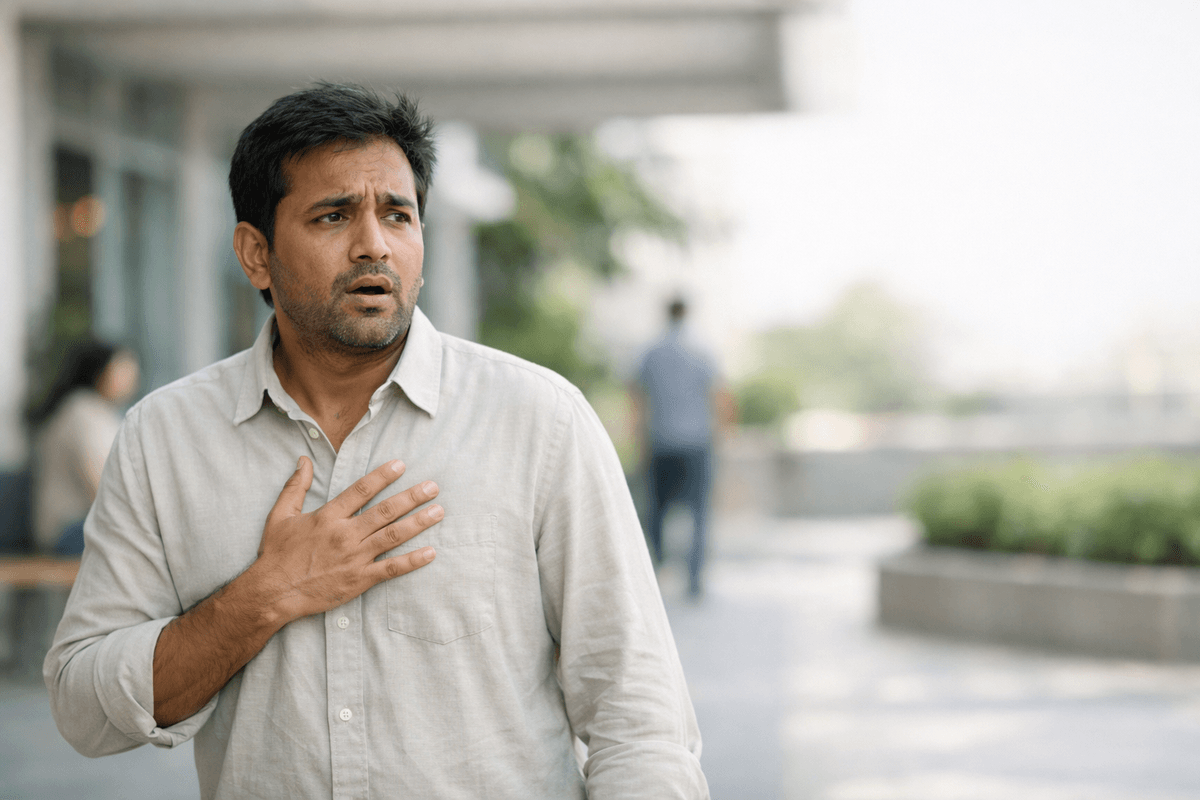
A racing heart, difficulty breathing, dizziness, the overwhelming certainty that you are about to die or lose control — and then, as suddenly as it came, it passes. The panic attack is over. But now you are afraid of the next one. And that fear is beginning to shape your life.
Recognition
Does This Feel Like You?
If any of the following sound familiar, you are not alone — and you have come to the right place.
You have had episodes of sudden, intense fear accompanied by physical symptoms — racing heart, breathlessness, dizziness, chest tightness, trembling, sweating
During these episodes, you were convinced something was seriously wrong — a heart attack, a stroke, that you were going to die or go mad
The episodes come without warning. They can happen anywhere: in a supermarket, at work, in bed, in the car
Since the first episode, you have been afraid of having another one — monitoring your body constantly for early warning signs
You have started avoiding places or situations where having a panic attack would be difficult or embarrassing
You carry reassurance — your phone, a bottle of water, a route to an exit — wherever you go, just in case
Emergency services have seen you, or you have had extensive cardiac or neurological investigations, all of which came back normal
Your world is getting smaller. Things you used to do without thinking twice now feel impossible to attempt
Understanding
What Panic disorder Actually Is
Panic disorder is characterised by recurrent, unexpected panic attacks — sudden surges of intense fear or discomfort that reach their peak within minutes and are accompanied by physical symptoms that closely mimic those of a medical emergency. These include racing or pounding heart, shortness of breath, chest pain, dizziness or lightheadedness, nausea, trembling, sweating, and a sense of unreality (derealisation or depersonalisation). At the height of a panic attack, most people are convinced they are having a heart attack, dying, or losing their mind.
Panic disorder is diagnosed when these attacks recur unexpectedly — not always in response to an identifiable trigger — and when the person develops significant anticipatory anxiety about further attacks, changes their behaviour to avoid situations in which attacks might occur, or both. The fear of the panic attack itself becomes as disabling as the attacks.
Many people with panic disorder also develop agoraphobia — a fear of situations in which escape might be difficult or help unavailable during a panic attack. This can range from mild avoidance of specific places to severe restriction of movement, in some cases to the point of being unable to leave home.
Panic disorder is highly treatable. The combination of psychological therapy (particularly CBT) and, where needed, medication produces significant improvement in the majority of people who engage with treatment — and full remission is achievable.
Clearing the air
What People Often Get Wrong
Misconceptions about Panic disorder cause real harm — they delay help and increase shame. Here is what is actually true.
Common belief
"Panic attacks are dangerous — the physical symptoms mean something is physically wrong"
What's actually true
Panic attacks, while terrifying, are not medically dangerous. The physical symptoms are produced by the body's fight-or-flight response and are real physiological events — but they cannot cause cardiac arrest, fainting (in most circumstances), or loss of control in the way that panic-driven thoughts suggest. Understanding this is central to recovery.
Common belief
"The safest response is to go somewhere safe and wait for it to pass"
What's actually true
Escaping from the situation when a panic attack begins reinforces the belief that the situation was genuinely dangerous. Over time, this avoidance narrows the range of situations the person can manage. Treatment for panic disorder involves learning to stay with the discomfort of panic rather than escaping from it.
Common belief
"If you avoid the situations that trigger panic, you will be fine"
What's actually true
Avoidance reduces panic attacks in the short term — and makes panic disorder significantly worse in the long term. Every avoided situation confirms the belief that it was unsafe, and the list of unsafe situations grows.
Common belief
"Panic disorder means you are mentally weak"
What's actually true
Panic disorder is a physiological and psychological condition involving an overactive alarm system. It has nothing to do with character, strength, or resilience. Many people with panic disorder function at a high level in demanding roles — and experience their attacks as entirely inconsistent with the rest of who they are.
Common belief
"Breathing into a paper bag is the right response to a panic attack"
What's actually true
This is outdated advice and is not recommended. Hyperventilation during a panic attack does alter blood CO2 levels, but the paper bag technique is not the right response and can be unsafe in some circumstances. There are far more effective techniques for managing the physiology of a panic attack, which are taught as part of CBT for panic disorder.
The science
Why This Happens
The panic attack itself results from the activation of the body's fight-or-flight response in the absence of genuine threat. The nervous system, for reasons that may not be immediately obvious, interprets a neutral bodily sensation — a slightly raised heart rate, a momentary dizziness — as a signal of danger, and escalates the physiological response accordingly. This escalation produces the physical symptoms of the panic attack, which are then interpreted as confirmation of danger, creating a rapidly intensifying feedback loop.
Panic disorder develops when the person begins to fear the panic attack itself — the anticipatory anxiety, the monitoring of bodily sensations for early warning signs, and the avoidance of situations in which panic might occur. This fear of fear is the engine that maintains panic disorder long after the initial attacks. Biological factors — a more sensitive autonomic nervous system, a lower threshold for the alarm response — increase vulnerability. Stress, physical illness, and significant life events often precipitate the first episode.
Many people experience their first panic attack during or after a period of significant stress or following a physical health event. Once panic disorder is established, the triggers become more diffuse — any internal sensation that resembles early panic can activate the alarm response.
Real impact
How Panic disorder Affects Daily Life
The effects go well beyond the symptoms themselves.
Freedom of movement
Avoidance of situations where panic might occur progressively restricts life. Driving, public transport, crowded places, distances from home — all can become restricted. In severe agoraphobia, some people cannot leave their home at all.
Work
Panic disorder can make it extremely difficult to maintain work that requires presence in particular environments, travel, or social exposure. Many people manage their panic by arranging their work life to accommodate it — which is sustainable only up to a point.
Relationships
Partners and family members are often drawn into the management of panic disorder — accompanying the person to avoided situations, providing reassurance, adjusting plans. This accommodation maintains the disorder and puts strain on relationships.
Physical health anxiety
The physical symptoms of panic attacks — chest pain, breathlessness, palpitations — are convincing enough that many people seek repeated emergency care and medical investigation before the panic disorder is identified. This health anxiety can become a separate, sustaining preoccupation.
Quality of life
The anticipatory anxiety — the constant readiness for the next attack — is as disabling as the attacks themselves. Living with the constant fear of panic is exhausting and significantly reduces quality of life.
Before seeking help
What Most Families Try First
Most people who come to us have already tried a lot of other things. If any of these sound familiar, you are not alone — and you have not failed.
Leaving or avoiding the situation when panic begins — which reduces distress in the moment and maintains the disorder in the longer term
Carrying "safety behaviours" — phones, water, medication, a companion — that reduce anxiety by providing an escape route, but reinforce the belief that the situation is unsafe
Seeking medical reassurance through emergency visits and investigations, which provides brief relief and does not address the underlying condition
Deep breathing and relaxation techniques as the primary response to panic — useful as a component of treatment but not sufficient on their own
Restricting activity to manage the panic — choosing jobs, social life, and daily routines around avoiding situations that might trigger an attack
Searching online for explanations of symptoms, often finding information that increases rather than reduces health anxiety
The process
How Panic disorder Is Diagnosed
Assessment for panic disorder involves understanding the nature of the attacks, the patterns of avoidance they have produced, and whether any other conditions are contributing.
- 1
A detailed first consultation covering the history of panic attacks — when the first one occurred, what the attacks feel like, how frequent they are, and how behaviour has changed since they began
- 2
Assessment of agoraphobia and the extent of avoidance — understanding how much of daily life has been reorganised around avoiding panic is essential for treatment planning
- 3
Evaluation of co-occurring conditions — depression, GAD, social anxiety, and PTSD can all co-occur with or be confused with panic disorder
- 4
A review of physical health and any medications or substances that might be contributing to or mimicking panic symptoms
- 5
A clear, honest formulation and treatment plan, explained in full before any decisions are made
People with panic disorder are often both relieved and surprised to learn that what they have been experiencing is a well-understood condition with highly effective treatment.
Ready to get clarity?
An accurate assessment is the starting point for everything. Dr. Divya takes the time to get it right — and to explain her findings clearly, without pressure.
Treatment
How We Help
Panic disorder responds very well to structured psychological treatment. Full remission — not just management but genuine freedom from panic — is achievable for many people.
Cognitive Behavioural Therapy (CBT) for panic disorder — the gold-standard treatment. Involves education about the panic cycle, graduated exposure to feared situations and sensations, and the systematic dismantling of avoidance and safety behaviours
Interoceptive exposure — a specific component of CBT for panic that involves deliberately inducing the physical sensations of panic in a controlled setting, building tolerance and breaking the association between those sensations and danger
Medication — SSRIs are effective for panic disorder and may be used alongside therapy or when therapy alone is insufficient. Benzodiazepines may be used short-term in specific circumstances but are not a long-term solution
Agoraphobia treatment — where significant avoidance has developed, graduated re-exposure to avoided situations is built into the treatment plan in a structured, supported way
Ongoing monitoring — panic disorder has a tendency to recur during periods of stress; Dr. Divya provides continued follow-up to consolidate recovery and respond early to any resurgence
This is part of our Adult Mental Health service — where you can learn more about Dr. Divya's full approach.
Outcomes
What Improves with the Right Support
We are always honest about what is realistic. With appropriate support and time, these are the changes families and individuals most often notice.
Panic attacks reduce in frequency and — crucially — the fear of panic attacks diminishes, which changes daily life more than any reduction in attacks alone
Avoidance patterns are dismantled — places, situations, and activities that were previously impossible become accessible again
The constant body-monitoring and hypervigilance quietens — the person stops living as a surveillance system for their own physiology
Better understanding of what panic is and what it is not — the symptoms become less frightening because they are understood
Restored quality of life — freedom to work, travel, socialise, and move through the world without planning every step around the risk of panic
Skills that last beyond the treatment period — the ability to recognise early panic and respond without escalation
Timing
When to Seek Help
Panic disorder typically does not improve without treatment — and the avoidance it produces tends to worsen over time.
-
You have had recurrent unexpected panic attacks and have been afraid of having further ones
-
You have changed your behaviour — avoided situations, restricted your life — because of panic attacks
-
Medical investigations for the physical symptoms have come back normal but the episodes continue
-
You are using alcohol or medication to prevent or manage panic attacks
-
Your world has become significantly smaller since the panic attacks began
Panic disorder is one of the most treatable conditions in psychiatry. Do not wait for the avoidance to become more established before seeking help.
Not sure if you need help?
It is completely okay to reach out just to ask. Dr. Divya is happy to help you work out whether an assessment is the right next step — with no pressure.
Common questions
Frequently Asked Questions
Am I actually going to die during a panic attack?
No. Panic attacks, while terrifying, are not medically dangerous. The symptoms are produced by the body's alarm system and cannot cause cardiac arrest, fainting (in most cases), or any other medical emergency in an otherwise healthy person. Part of the treatment is learning — truly learning, not just being told — that the sensations are uncomfortable but not dangerous.
My panic attacks seem to come out of nowhere. How can I treat something with no trigger?
The "out of nowhere" quality of panic attacks is one of their most frightening features — and one of the most treatable. Treatment teaches you to recognise the internal triggers (bodily sensations, subtle thoughts) that precede apparent spontaneous attacks, and to respond to them differently before they escalate. The attacks are not truly random; they feel that way because the triggers are internal rather than external.
Do I need medication?
Not necessarily. CBT alone is highly effective for panic disorder, and many people achieve full remission without medication. Medication becomes more relevant where panic is severe, where therapy is not producing adequate improvement, or where co-occurring depression requires treatment. The decision is always made collaboratively.
I have had panic attacks since my teens. Can this still be treated?
Yes. The duration of the panic disorder does not significantly limit the effectiveness of treatment. Established patterns of avoidance may require more gradual, sustained work to dismantle, but full recovery is achievable regardless of how long the condition has been present.
What do I do during a panic attack right now?
The most important thing is to stay where you are rather than escaping, and to allow the attack to run its course rather than fighting it. Panic attacks peak within about 10 minutes and resolve on their own. Trying to suppress them or escape from them prolongs and amplifies them. Slow, steady breathing helps — not because it "fixes" the panic, but because it gives the nervous system a signal to begin calming. Your treatment will teach you a structured approach to managing attacks from the inside.
Also worth reading
Related Conditions
Panic disorder is not who you are. And it is eminently treatable.
Book a consultation with Dr. Divya C.R. at Intune Mind, Coimbatore. In-person and telepsychiatry appointments available.