Autism spectrum disorder
When your child experiences the world differently from those around them
Autism is not a problem to be fixed. But without understanding and the right support, autistic children — and their families — can struggle enormously. An accurate assessment is the beginning of understanding what your child actually needs.
Recognition
Does This Feel Like You?
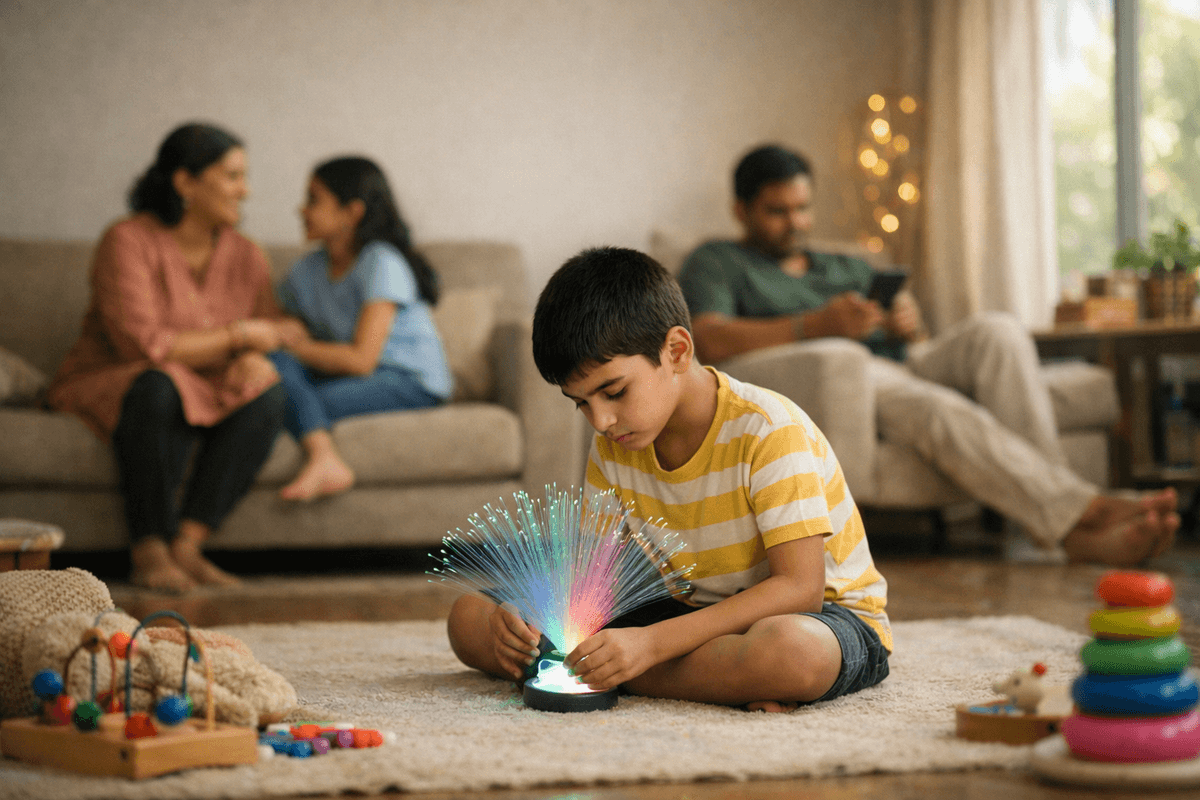
If any of the following sound familiar, you are not alone — and you have come to the right place.
Your child has significant difficulty with social interaction — reading cues, understanding unspoken rules, or forming friendships
They become intensely distressed by changes in routine, unexpected events, or sensory experiences others barely notice
They have very focused, deep interests in particular topics that dominate their attention
Language development was delayed, unusual in quality, or has some characteristics that feel different from other children
They take language very literally, missing jokes, sarcasm, or implied meaning
Noisy, crowded, or bright environments cause significant distress — meltdowns, shutdowns, or avoidance
They struggle to make or keep friends despite genuinely wanting connection
You have had concerns for a long time but been told they are "just shy" or that they will grow out of it
Understanding
What Autism spectrum disorder Actually Is
Autism spectrum disorder (ASD) is a neurodevelopmental condition characterised by differences in social communication, social interaction, and patterns of behaviour, interests, and sensory processing. It is present from birth, though it may not become apparent — or may not be recognised — until the social and communicative demands of the environment increase.
Autism is a spectrum. This means the way it presents, and the level of support a person needs, varies enormously from one individual to another. Some autistic children have significant cognitive or language difficulties. Others are academically capable and verbally fluent but struggle deeply with social navigation, sensory sensitivities, and the exhaustion of masking in a world that was not designed for them.
ASD is not caused by parenting, by vaccines, or by childhood experiences. It is a lifelong neurological difference — but with understanding, appropriate support, and the right environment, autistic children can flourish.
In India, autism remains significantly underdiagnosed — particularly in girls, in children without intellectual disability, and in children who have learned to mask their difficulties in social settings.
Clearing the air
What People Often Get Wrong
Misconceptions about Autism spectrum disorder cause real harm — they delay help and increase shame. Here is what is actually true.
Common belief
"All autistic children look the same"
What's actually true
Autism is a spectrum. Some autistic children are non-speaking; others are academically high-achieving. Some are immediately identifiable; others mask so effectively that their difficulties are invisible until they are in crisis. No two presentations are identical.
Common belief
"Girls cannot be autistic"
What's actually true
Girls are significantly underdiagnosed because they are more likely to mask — learning to imitate social behaviour and suppress their natural responses. This masking takes an enormous psychological toll. Autism in girls is common; it is recognition that has been lacking.
Common belief
"Autism is caused by bad parenting or vaccines"
What's actually true
This is false. Autism is a neurodevelopmental condition with a strong genetic basis. It is not caused by parenting style, vaccines, diet, or any postnatal experience. The vaccine myth has been thoroughly and repeatedly disproven.
Common belief
"Autistic people lack empathy"
What's actually true
Many autistic people feel empathy deeply — sometimes more intensely than non-autistic people. What differs is the ability to read and express emotions in the typical ways that neurotypical people expect. This is a communication difference, not an absence of feeling.
Common belief
"They just need to try harder to fit in"
What's actually true
The effort autistic children expend to navigate a world designed for neurotypical minds is already enormous. Asking them to 'try harder' without providing understanding or accommodation adds burden without providing any real help.
The science
Why This Happens
Autism is substantially genetic. Having a family member with autism, ADHD, or certain other neurodevelopmental conditions increases the likelihood. No single gene causes autism — it involves many genetic variants that interact with each other and with the environment during brain development.
The exact mechanisms are not fully understood, and active research continues. What is clear is that autism reflects genuine differences in how the brain is wired — differences in neural connectivity, sensory processing, and social cognition that are present from the very beginning of life. These differences are not deficits to be eliminated; they are part of a person. The goal of support is not to make an autistic person neurotypical, but to help them navigate the world with less distress and greater wellbeing.
Real impact
How Autism spectrum disorder Affects Daily Life
The effects go well beyond the symptoms themselves.
School
School environments — noisy, unpredictable, socially demanding, and transition-heavy — can be profoundly difficult for autistic children. Academic potential is often not realised because the environment itself is disabling.
Friendships and social life
Social navigation is one of the greatest challenges. Many autistic children desperately want connection but find the unspoken rules of peer interaction impossible to decode. Loneliness and social exclusion are common and genuinely painful.
Mental health
Anxiety, depression, and burnout are extremely common in autistic individuals — particularly in those who have masked for long periods. The co-occurrence of autism and mental health difficulties is the rule rather than the exception in clinical settings.
Family life
Raising an autistic child involves navigating a system — schools, healthcare, support services — that can be exhausting and fragmented. Parents often carry enormous emotional, practical, and advocacy loads, often with limited support themselves.
Sensory experience
Sensory sensitivities can make everyday environments — shops, classrooms, public transport, family gatherings — genuinely overwhelming. This is not dramatic behaviour; it is a neurological response to a world calibrated for a different kind of nervous system.
Before seeking help
What Most Families Try First
Most people who come to us have already tried a lot of other things. If any of these sound familiar, you are not alone — and you have not failed.
Being told by well-meaning people that the child is "just a bit different" or "immature" — and waiting
Attributing the difficulties to parenting, family stress, or the child's personality
Focusing on the most visible behaviours without understanding what is driving them
Requesting school support without an underlying diagnosis, which often limits what can be provided
Seeking informal online information, which is variable in quality and can increase rather than reduce confusion
Going through multiple partial assessments that raise questions but do not reach a conclusion
The process
How Autism spectrum disorder Is Diagnosed
Autism assessment is a clinical process that builds a comprehensive picture of the child across different settings and across development. It cannot be done in one appointment.
- 1
A detailed developmental history from parents — covering early milestones, social communication from infancy, sensory sensitivities, early language, play, and the child's current profile of strengths and difficulties
- 2
Structured behavioural observation and clinical interview with the child — adapted to their age and communication style
- 3
Parent-completed and teacher-completed rating scales that capture the child's behaviour across home and school settings
- 4
Assessment of co-occurring conditions — ADHD, anxiety, learning difficulties, and mood disorders are extremely common in autistic children and must be assessed alongside the ASD assessment
- 5
Clear, compassionate feedback to the family — including what the diagnosis means, what it does not mean, and what to do next
A diagnosis of autism is not a life sentence. It is a framework that makes sense of experiences that may have been confusing for years — and it is the starting point for appropriate support.
Ready to get clarity?
An accurate assessment is the starting point for everything. Dr. Divya takes the time to get it right — and to explain her findings clearly, without pressure.
Treatment
How We Help
Post-diagnosis support is as important as the assessment itself. Understanding the diagnosis is the beginning.
Comprehensive ASD assessment — thorough, sensitive, and designed to identify the child's specific profile of strengths and support needs
ADHD assessment and management — ADHD co-occurs in a significant proportion of autistic children, and treating it can produce substantial improvements in functioning
Anxiety assessment and treatment — anxiety is the most common co-occurring mental health condition in autism, and it is treatable
Parent guidance and psychoeducation — helping families understand their child's profile, what it means practically, and how to advocate effectively within school and healthcare systems
School support documentation — providing information and recommendations that can be used to obtain appropriate accommodations, resources, and adjustments
Individual therapy adapted for autistic young people — CBT and other approaches can be adapted to address anxiety, emotional regulation, and social challenges when delivered by a clinician with autism-specific knowledge
This is part of our Child & Adolescent Mental Health service — where you can learn more about Dr. Divya's full approach.
Outcomes
What Improves with the Right Support
We are always honest about what is realistic. With appropriate support and time, these are the changes families and individuals most often notice.
A family that finally understands why things have been so hard — and stops blaming themselves or their child
Appropriate school accommodations and adjustments that allow the child to access learning without the environment itself being the barrier
Reduced anxiety as the environment becomes more predictable and the child develops better coping strategies
A child who understands themselves — and begins to build a positive identity around their difference, not just a sense of being broken
Better management of co-occurring ADHD or anxiety, with significant downstream improvements in daily functioning
Parents who feel less alone, better informed, and better equipped to advocate
Timing
When to Seek Help
If you have ongoing concerns about your child's social communication, sensory responses, or patterns of behaviour, it is worth seeking an assessment — even if others have told you there is nothing to worry about.
-
Significant difficulty with social interaction, making friends, or understanding social cues
-
Intense distress at changes in routine, transitions, or sensory input
-
Unusually deep or narrow interests combined with difficulties in other areas
-
Language that is unusual in quality, very literal, or that developed atypically
-
A persistent sense that your child is struggling in ways that are not explained by anything you or the school have tried
Trust your instincts. A thorough assessment either provides a diagnosis that opens the door to support, or it rules it out clearly. Either outcome is useful.
Not sure if you need help?
It is completely okay to reach out just to ask. Dr. Divya is happy to help you work out whether an assessment is the right next step — with no pressure.
Common questions
Frequently Asked Questions
Is it too late to diagnose autism in an older child or teenager?
It is never too late. Many autistic individuals are not diagnosed until adolescence or even adulthood — particularly those who have masked effectively or who did not meet the stereotype. A later diagnosis is not a lesser diagnosis. It still provides a framework for understanding and access to support.
Will a diagnosis limit my child's future?
A diagnosis does not limit a child's future — in most cases, it makes it more possible. Undiagnosed autistic children often struggle unnecessarily, sometimes for years. A diagnosis opens the door to appropriate support, accommodations, and self-understanding that makes success far more achievable.
My child does not look autistic to me. Could they still be?
Autism looks very different across individuals. Many autistic children — particularly girls, and those with average or high intelligence — mask their difficulties so effectively that they appear to be managing fine. The exhaustion behind that masking is often invisible until the child is in crisis.
Will my child need to go to a special school?
Most autistic children attend mainstream schools — sometimes with support, sometimes without. The right placement depends on the individual child's needs and the support available in different settings. This is something that is worked out collaboratively based on a thorough understanding of the child.
Can autism be treated or cured?
Autism is not a disease to be cured. It is a neurodevelopmental difference that is part of who the person is. Support focuses on reducing distress, building skills, creating accessible environments, and improving quality of life — not on eliminating autism itself.
Also worth reading
Related Conditions
Understanding changes everything.
Book a consultation with Dr. Divya C.R. at Intune Mind, Coimbatore. In-person and telepsychiatry appointments available.