Eating difficulties in adolescents
When food and your child's body have become a source of fear, shame, or control
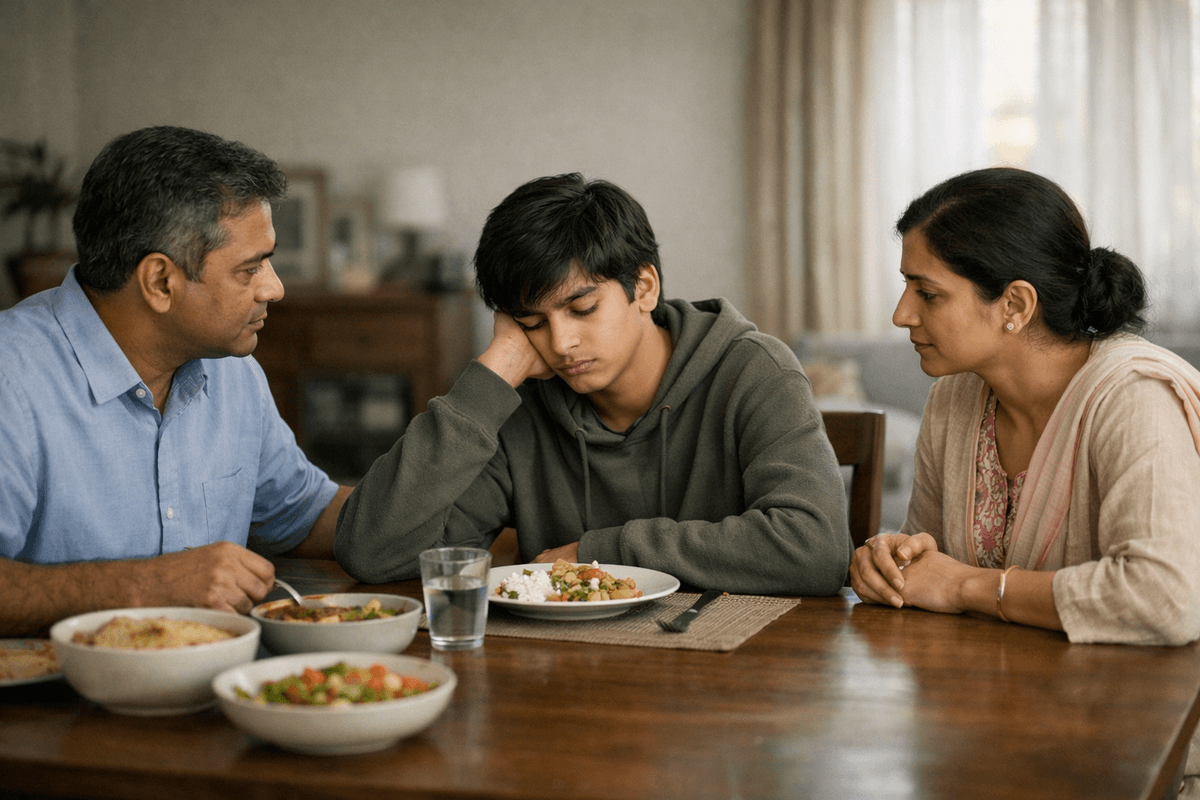
It might have started as dieting, or being "healthy", or just being picky. But now meals are battlegrounds, their relationship with food looks nothing like it should, and you are genuinely frightened. Eating difficulties in young people are serious — and they respond to the right help.
Recognition
Does This Feel Like You?
If any of the following sound familiar, you are not alone — and you have come to the right place.
Your child is restricting what they eat significantly — avoiding entire food groups, eating tiny amounts, or refusing meals — and the restriction is getting worse
They talk about their body in ways that worry you — believing they are fat when they are not, expressing intense disgust or shame about how they look
Meals have become sources of significant distress — anxiety, arguments, tears, or complete refusal
You have found evidence of bingeing — large amounts of food disappearing — or of purging: vomiting, laxatives, or excessive exercise after eating
They have lost weight noticeably, or their weight is fluctuating in ways that concern you
They are preoccupied with food, calories, weight, or their body in a way that dominates their thinking and conversations
Their social life has narrowed significantly — avoiding situations that involve food, withdrawing from friends and family
Your gut is telling you something is seriously wrong — and when you try to raise it, they shut down, deny it, or become very distressed
Understanding
What Eating difficulties in adolescents Actually Is
Eating difficulties in adolescents cover a spectrum of conditions that are united by a disturbed relationship with food, eating, and the body. The most commonly recognised are anorexia nervosa (severe restriction of intake, intense fear of weight gain, and a distorted body image), bulimia nervosa (cycles of bingeing followed by purging through vomiting, laxatives, or excessive exercise), and binge eating disorder (recurrent episodes of eating large amounts in a short time, accompanied by shame and distress, without compensatory purging). Avoidant/restrictive food intake disorder (ARFID) involves significant food restriction not driven by body image concerns — often related to sensory sensitivity, fear of choking, or extreme food aversion.
Many young people fall between these categories — with disordered eating patterns that are clinically significant and require treatment but do not fit neatly into a single diagnosis. What matters is not the label but the impact: on physical health, on mental health, and on the young person's ability to live their life.
Eating difficulties are among the most medically serious of all psychiatric conditions in young people. Anorexia nervosa in particular carries significant physical risks that require monitoring and, in severe cases, medical intervention alongside psychiatric treatment. Early assessment and intervention produce substantially better outcomes than delayed treatment — which makes taking warning signs seriously, without waiting to see how things develop, extremely important.
Clearing the air
What People Often Get Wrong
Misconceptions about Eating difficulties in adolescents cause real harm — they delay help and increase shame. Here is what is actually true.
Common belief
"It's just a phase — all teenagers are fussy about food"
What's actually true
Normal teenage fussiness is very different from a clinically significant eating disorder. The scale of restriction, the intensity of the distress around food, the distorted body image, and the impact on physical health and daily functioning are not features of ordinary adolescent eating behaviour. Taking warning signs seriously early produces much better outcomes than waiting.
Common belief
"Eating disorders only happen to very thin girls"
What's actually true
Eating disorders affect young people of all genders, all body sizes, and all backgrounds. Bulimia and binge eating disorder often occur at average or above-average body weight and can be missed because the person "doesn't look like they have an eating disorder." Disordered eating in boys is frequently unrecognised and undertreated.
Common belief
"They are doing it for attention or to be difficult"
What's actually true
Eating disorders are not choices, performances, or manipulation. They are serious mental health conditions with complex neurobiological and psychological drivers. The shame and secrecy that often characterise eating disorders are the opposite of attention-seeking behaviour.
Common belief
"They just need to eat — if you make them eat, they will be fine"
What's actually true
Nutritional rehabilitation is essential for recovery, particularly in anorexia nervosa — a malnourished brain cannot engage effectively with psychological treatment. But refeeding without addressing the psychological drivers typically produces temporary weight restoration followed by relapse. Both are necessary.
Common belief
"It's caused by social media and cultural pressure"
What's actually true
Social media and cultural messages about bodies are risk factors that can trigger and maintain eating difficulties in vulnerable young people. But eating disorders arise from a complex interaction of genetic predisposition, temperament, psychological vulnerability, and environment. Many young people exposed to the same cultural messages do not develop eating disorders. Understanding the full picture matters for treatment.
The science
Why This Happens
Eating disorders develop through the interaction of biological, psychological, and social factors. There is a strong genetic component — having a close family member with an eating disorder significantly increases risk. Temperamental traits that appear consistently in those who develop eating disorders include perfectionism, high anxiety, and a tendency towards rigidity and rule-following. The restriction or control of food becomes a way of managing emotions and an overwhelming sense of anxiety — for many young people, the eating disorder provides a sense of control and competence in the context of a life that feels chaotic or overwhelming.
Body image dissatisfaction — driven by cultural messaging, social comparison, comments from peers or family, and a developing adolescent identity — plays a significant role in onset. For some young people, dieting begins as an attempt to manage body dissatisfaction and escalates into a full eating disorder. For others, the restriction begins as a response to anxiety, trauma, or another emotional difficulty, and the body image distortion develops as a consequence of malnutrition.
ADHD is increasingly recognised as a significant risk factor for eating difficulties — impulsivity, difficulty with emotional regulation, and disrupted hunger and fullness cues all contribute. Anxiety disorders, OCD, and depression frequently co-occur with eating difficulties and must be addressed as part of treatment.
Real impact
How Eating difficulties in adolescents Affects Daily Life
The effects go well beyond the symptoms themselves.
Physical health
Malnutrition affects every organ system. Cardiac complications, bone density loss, hormonal disruption, and effects on brain development are among the most serious consequences of eating disorders in young people. Medical monitoring is an essential part of treatment.
Cognitive functioning
A malnourished brain cannot function at its normal level. Concentration, memory, decision-making, and emotional regulation all deteriorate with significant under-nutrition — which makes the psychological work of recovery genuinely harder without nutritional restoration.
Social life
Adolescence is built around social eating — lunches at school, meals with friends, celebrations. Eating difficulties remove access to these experiences, creating increasing social isolation at a critical developmental period.
Family relationships
Every meal becomes a potential conflict. Families reorganise around the eating disorder. Parents feel desperate, frightened, and helpless. Siblings are affected. The fear of saying the wrong thing can make normal family interaction feel impossible.
Academic performance
Malnutrition, obsessive food-related thinking, and the emotional weight of the eating disorder all reduce the cognitive and emotional resources available for learning. Academic performance typically deteriorates significantly.
Before seeking help
What Most Families Try First
Most people who come to us have already tried a lot of other things. If any of these sound familiar, you are not alone — and you have not failed.
Reasoning and negotiating at mealtimes — trying to talk the young person into eating, which typically escalates the conflict without addressing the underlying driver
Making food the explicit focus — watching what they eat, commenting on portions, monitoring — which can increase the anxiety and shame that maintain the disorder
Searching for a "safe" food list and restricting family meals to only those foods — which accommodates the disorder rather than treating it
Assuming it will pass on its own once the social pressure that seemed to trigger it eases
Consulting a dietitian without a concurrent psychiatric assessment — which addresses nutrition without the psychological treatment that is equally necessary
Waiting until it becomes "serious enough" — not knowing that eating disorders are always serious, and that earlier treatment produces better outcomes
The process
How Eating difficulties in adolescents Is Diagnosed
Assessment for eating difficulties in young people involves understanding the full picture — the eating behaviour, the body image, the psychological drivers, and the physical health — before any treatment plan is agreed.
- 1
A detailed first consultation with Dr. Divya — covering the history of the eating difficulty, the specific patterns of restriction, bingeing, or purging, and how it is affecting daily life
- 2
A clinical interview with the young person themselves — conducted sensitively, recognising that many young people with eating disorders feel ambivalent about treatment and need to feel genuinely heard rather than judged
- 3
Assessment of co-occurring conditions — anxiety, depression, OCD, ADHD, and trauma history are all explored, as they frequently co-occur with eating difficulties
- 4
A review of physical health indicators, with guidance on what medical investigations and monitoring are needed alongside psychiatric treatment
- 5
An honest discussion with the family about the findings and a collaborative discussion of what treatment would look like — including what role the family will play
Family involvement is one of the strongest predictors of good outcomes in adolescent eating disorders. Assessment recognises this from the start.
Ready to get clarity?
An accurate assessment is the starting point for everything. Dr. Divya takes the time to get it right — and to explain her findings clearly, without pressure.
Treatment
How We Help
Treatment for eating difficulties in young people is most effective when it integrates psychological treatment, family involvement, and medical monitoring — delivered in a coordinated way.
Family-Based Treatment (FBT) — the most evidence-based approach for adolescent anorexia and bulimia. Parents are placed in charge of nutritional rehabilitation while the young person's autonomy is gradually restored as recovery progresses
Individual therapy — CBT-E (Enhanced Cognitive Behavioural Therapy for eating disorders) for older adolescents, addressing the cognitions and behaviours that maintain the eating disorder alongside any co-occurring anxiety or depression
Assessment and treatment of co-occurring conditions — ADHD, anxiety, OCD, and depression are treated directly, which reduces the emotional load that the eating disorder is managing
Nutritional rehabilitation guidance — working with dietetic support where needed to restore physical health as a foundation for psychological recovery
Medical monitoring coordination — ensuring appropriate physical health oversight, particularly for young people with significant weight loss or purging behaviours
Inpatient or higher-level care referral — for cases where medical risk is high or outpatient treatment is not progressing, Dr. Divya can coordinate referral to appropriate specialist services
This is part of our Child & Adolescent Mental Health service — where you can learn more about Dr. Divya's full approach.
Outcomes
What Improves with the Right Support
We are always honest about what is realistic. With appropriate support and time, these are the changes families and individuals most often notice.
A more normalised relationship with food — meals become less fraught, more variety is possible, eating in social situations becomes manageable again
A less distorted, less hostile relationship with the body — more acceptance, less preoccupation
Physical health restoration — weight, energy, hormonal function, and cognitive capacity all improve with nutritional recovery
Reduced anxiety and emotional distress — as the eating disorder's grip loosens and healthier ways of managing emotion are developed
Social reconnection — returning to school, friendships, and the normal activities of adolescence
A family that feels less desperate and more capable of supporting recovery, with a clearer understanding of the condition and how to respond
Timing
When to Seek Help
Eating difficulties in young people are always worth taking seriously. Do not wait for things to become medically critical.
-
Your child is significantly restricting food intake, has stopped eating entire food groups, or has lost noticeable weight
-
You have found evidence of purging — vomiting, laxatives, or excessive exercise used to compensate for eating
-
They are intensely preoccupied with food, calories, and their body in ways that dominate daily life
-
They are avoiding meals, social situations involving food, or any food-related context
-
They are expressing intense body dissatisfaction or distorted beliefs about their weight or shape
-
Your instinct as a parent is telling you something is seriously wrong
Eating disorders are among the most serious mental health conditions in adolescence. Early assessment and early treatment produce substantially better outcomes. If you are worried, seek an assessment now — not later.
Not sure if you need help?
It is completely okay to reach out just to ask. Dr. Divya is happy to help you work out whether an assessment is the right next step — with no pressure.
Common questions
Frequently Asked Questions
My child is not underweight. Can they still have an eating disorder?
Yes — most people with eating disorders are not underweight. Bulimia nervosa, binge eating disorder, and ARFID can all occur at any body weight. A young person can be severely medically compromised by restriction even before their weight drops to a level that is visually obvious. Body weight is not a measure of the severity of an eating disorder.
My son has eating difficulties. Is this less common in boys?
Eating disorders do occur more frequently in girls and young women, but they occur in boys too — and are significantly underdiagnosed in males because neither families nor clinicians expect it. In adolescent boys, eating disorders sometimes present differently — driven more by a desire to be muscular than to be thin, or with less overt body image language. The suffering is equally real.
Should we be managing what they eat at home?
In Family-Based Treatment, parents do take temporary control of nutritional decisions as a deliberate, structured intervention. But outside of that structured approach, uncoordinated monitoring and control of eating at home can increase conflict and shame without producing recovery. How to manage food and meals at home is something to discuss explicitly as part of the treatment plan.
How long does treatment take?
Recovery from an eating disorder is typically measured in months to years, not weeks. This is not because treatment is ineffective — it is because eating disorders involve deeply held beliefs, physiological changes from malnutrition, and entrenched behavioural patterns that take time to shift. Consistent, sustained engagement with treatment produces genuine recovery. Half-hearted or incomplete treatment typically produces partial recovery followed by relapse.
What should I say — and not say — at mealtimes?
What to say at mealtimes, how to respond to refusal, and how to manage the inevitable conflict are things that are worked through directly in parent guidance sessions. There are evidence-based approaches to this that make a real difference to mealtime dynamics. Specific guidance tailored to your child and your family situation is far more useful than general principles.
Also worth reading
Related Conditions
Early help changes outcomes. Do not wait.
Book a consultation with Dr. Divya C.R. at Intune Mind, Coimbatore. In-person and telepsychiatry appointments available.