Sleep problems in children
When your child cannot sleep — and the whole family is paying the price
You have tried earlier bedtimes, no screens, warm milk, and every routine the internet recommends. But night after night, your child lies awake, comes to your room, or wakes repeatedly — and by morning everyone is running on empty. Sleep problems in children are almost always connected to something else. Finding out what is the first step.
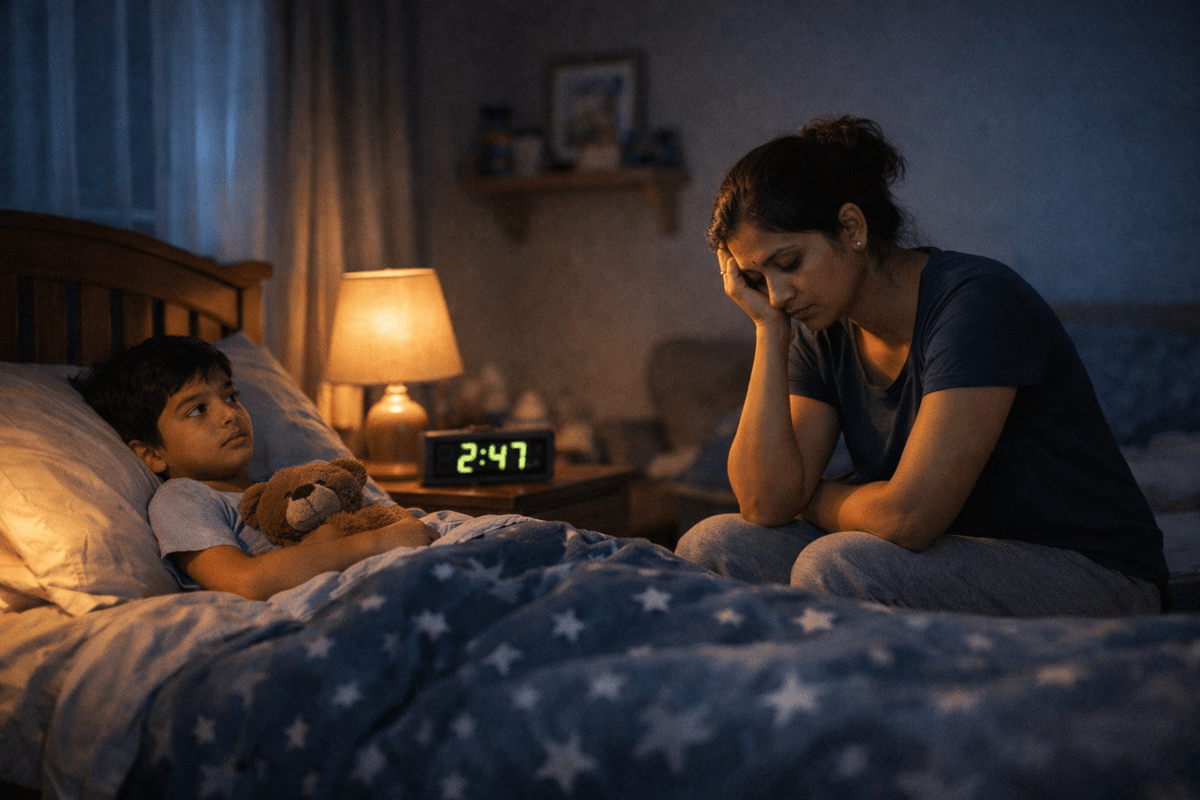
Recognition
Does This Feel Like You?
If any of the following sound familiar, you are not alone — and you have come to the right place.
Your child takes an hour or more to fall asleep, despite going to bed at a reasonable time and following a routine
They wake repeatedly through the night, cannot settle themselves back to sleep, and come to you every time
Nightmares or night terrors are frequent — they wake distressed, sometimes screaming, and take a long time to calm
They refuse to sleep alone, cannot be in their room without you, or insist on sleeping in your bed every night
They are tired during the day — irritable, unfocused, and struggling to get through school — but still cannot switch off at night
They use devices until late and you cannot get the situation under control, even when you know it is not helping
The bedtime routine has become a battle lasting hours, affecting the whole household
You are exhausted. You have not had an uninterrupted night's sleep in months — and neither has your child
Understanding
What Sleep problems in children Actually Is
Sleep problems in children encompass a range of difficulties: trouble falling asleep (sleep-onset insomnia), frequent night waking, early waking, nightmares and night terrors, sleepwalking, and resistance to sleeping alone. Some children have difficulty in all of these areas; others struggle with just one.
Sleep problems in children are rarely just about sleep. They are almost always connected to something else — anxiety is the most common driver, particularly in children who cannot settle their minds at bedtime or who are frightened to be alone in the dark. ADHD is strongly associated with sleep difficulties; the same neurological differences that affect attention regulation also disrupt the brain's ability to wind down. Depression changes sleep architecture, producing early waking and unrefreshing rest. Trauma disrupts sleep through nightmares and hypervigilance. Even without a diagnosable condition, significant stress, life changes, or a history of poor sleep habits can establish patterns that become very difficult to break without professional support.
The consequences of poor sleep extend far beyond tiredness. Sleep is when the brain consolidates memory, regulates mood, and restores itself. A child who is chronically sleep-deprived will struggle to learn, regulate emotions, manage social situations, and sustain attention — producing difficulties that can look like ADHD or emotional problems in their own right. For this reason, sleep difficulties are worth taking seriously and addressing directly.
Clearing the air
What People Often Get Wrong
Misconceptions about Sleep problems in children cause real harm — they delay help and increase shame. Here is what is actually true.
Common belief
"They are just being difficult at bedtime — they need firmer boundaries"
What's actually true
Some children do need firmer, clearer bedtime boundaries — but for many, the inability to settle is driven by genuine anxiety, a dysregulated nervous system, or an underlying condition that makes falling asleep genuinely difficult. Firmness without understanding what is driving the difficulty often makes bedtime worse, not better.
Common belief
"All children need the same amount of sleep"
What's actually true
Sleep needs vary between children, but the ranges for each age group are well established. A child who consistently sleeps significantly less than recommended for their age is not simply a child who "needs less sleep" — they are a child who is chronically sleep-deprived and needs support.
Common belief
"Screens before bed are the main cause — remove them and it will resolve"
What's actually true
Screen use before bed does disrupt sleep by suppressing melatonin and increasing arousal. But for many children, removing screens alone does not solve the problem, because the underlying driver — anxiety, ADHD, or another condition — is still present. Screens often become how anxious children manage the fear of lying awake in the dark.
Common belief
"They will grow out of it"
What's actually true
Some sleep difficulties do resolve naturally with age and development. But established insomnia and anxiety-related sleep problems tend to persist without intervention, and the downstream effects on mental health, learning, and behaviour accumulate in the meantime.
Common belief
"Co-sleeping is always a problem"
What's actually true
Co-sleeping becomes a problem when it is driven by anxiety, when it is preventing the child from developing the capacity to self-settle, or when it is unsustainable for the family. Understanding why it is happening matters more than the behaviour itself.
The science
Why This Happens
The ability to fall and stay asleep relies on a brain that is calm, a body that is tired, and an internal clock that is well regulated. Anxiety disrupts the first of these — the racing, worrying mind at bedtime is one of the most common presentations of childhood anxiety. ADHD disrupts all three — attention dysregulation makes it genuinely difficult to disengage from stimulation, the body is often not physically tired enough for age, and the circadian clock is frequently shifted later.
Trauma disrupts sleep directly through nightmares and a nervous system that remains in a state of alert. Depression alters sleep architecture in ways that produce early waking, unrefreshing sleep, and an altered relationship between tiredness and the ability to rest. In the absence of a diagnosable condition, poor sleep habits established early — inconsistent routines, difficulty self-settling, reliance on a parent's presence to sleep — can become deeply entrenched and very difficult for families to change without guidance.
Adolescence adds a further layer of complexity. Puberty shifts the circadian rhythm significantly later, meaning teenagers are biologically primed to fall asleep later and wake later. School start times that are misaligned with this biological shift produce chronic sleep deprivation in a significant proportion of adolescents — not because of phone use or laziness, but because of developmental biology.
Real impact
How Sleep problems in children Affects Daily Life
The effects go well beyond the symptoms themselves.
School performance
Sleep is essential for memory consolidation and sustained attention. Chronically sleep-deprived children underperform academically relative to their ability, and their difficulties are often misattributed to laziness, lack of effort, or learning difficulties.
Emotional regulation
The prefrontal cortex — responsible for emotional regulation and impulse control — is particularly sensitive to sleep deprivation. Children who are consistently under-slept are more irritable, more reactive, and less able to manage frustration. This can look like ADHD or conduct problems.
Physical health
Chronic sleep deprivation in childhood is associated with a range of physical health consequences, including impacts on immune function, growth hormone secretion, and long-term cardiovascular health.
Family life
When a child is not sleeping, neither is the rest of the family. Parental sleep deprivation reduces the capacity for calm, responsive parenting — which can inadvertently maintain the very patterns that are disrupting the child's sleep.
Mental health
The relationship between sleep and mental health runs in both directions. Poor sleep worsens anxiety and depression; anxiety and depression worsen sleep. Without addressing both sides of this cycle, neither resolves.
Before seeking help
What Most Families Try First
Most people who come to us have already tried a lot of other things. If any of these sound familiar, you are not alone — and you have not failed.
Earlier bedtimes — which sometimes help but can backfire if the child lies awake longer, increasing anxiety about not being able to sleep
Screen bans at bedtime — helpful but often insufficient when anxiety or another condition is the primary driver
Sleep hygiene routines — useful as part of a comprehensive approach but rarely sufficient on their own when an underlying condition is present
Melatonin — available over the counter in India and often tried without medical guidance; it can be appropriate in some cases but is not a solution for sleep difficulties that have a psychological or psychiatric driver
Letting the child stay up later — removing the battle but not the underlying problem
Allowing indefinite co-sleeping to restore peace — which helps short-term but can establish a dependency that becomes very difficult to resolve over time
The process
How Sleep problems in children Is Diagnosed
Assessment for sleep problems in children begins with a detailed understanding of the sleep pattern itself and then looks carefully at what might be driving it.
- 1
A detailed first consultation with Dr. Divya covering the nature of the sleep difficulty — what the child's sleep looks like from bedtime to morning, how long it has been this way, and what has already been tried
- 2
Exploration of the child's mental health picture — anxiety, ADHD, depression, and trauma are all assessed, as they are the most common psychiatric drivers of sleep difficulties in children
- 3
A review of sleep habits, routine, environment, and daytime activity — to identify any behavioural or environmental factors that may be maintaining the problem
- 4
Where relevant, a sleep diary completed by parents over one to two weeks before the consultation — providing an accurate picture of the sleep pattern rather than a recalled approximation
- 5
Clear, honest feedback on what is understood to be driving the difficulty and a practical treatment plan
In most cases, sleep problems in children are entirely treatable once what is driving them is understood. Assessment is the essential first step.
Ready to get clarity?
An accurate assessment is the starting point for everything. Dr. Divya takes the time to get it right — and to explain her findings clearly, without pressure.
Treatment
How We Help
Effective treatment for sleep problems in children addresses both the sleep difficulty directly and any underlying condition that is driving it.
Assessment and treatment of underlying conditions — anxiety, ADHD, depression, and trauma are treated in their own right, which typically produces significant improvement in sleep as a downstream effect
Cognitive Behavioural Therapy for Insomnia adapted for children (CBT-I) — the most evidence-based psychological treatment for insomnia. Addresses the thoughts, beliefs, and behaviours that maintain poor sleep and builds the conditions for reliable, restorative rest
Parent guidance on sleep hygiene, routines, and managing bedtime resistance — practical strategies adapted to the child's age and the specific pattern of difficulty
Graduated approaches to re-establishing independent sleep — for children who have become dependent on parental presence to sleep, a carefully paced, consistent programme that builds their confidence and capacity to self-settle
Medication — considered when the sleep difficulty is severe, or when an underlying condition (such as ADHD) warrants pharmacological support. Always discussed fully and is never the default starting point
This is part of our Child & Adolescent Mental Health service — where you can learn more about Dr. Divya's full approach.
Outcomes
What Improves with the Right Support
We are always honest about what is realistic. With appropriate support and time, these are the changes families and individuals most often notice.
A child who can fall asleep within a reasonable time after going to bed — without hours of lying awake or requiring constant parental reassurance
Fewer night wakings, and a child who can settle themselves when they do wake without coming to the parents
Reduced nightmares and night terrors, or a child who can manage them when they occur
Better mood, more consistent emotional regulation, and improved concentration during the day
A bedtime routine that is manageable rather than a daily battle
A family that is rested — which changes everything about daily life and the capacity to respond to the child with patience and consistency
Timing
When to Seek Help
Sleep difficulties are worth taking seriously — and worth getting help with sooner rather than later.
-
Sleep difficulties have been significantly impacting the child for more than a month and are not improving
-
The child is visibly exhausted during the day and the sleep problem is affecting school, behaviour, or mood
-
Nightmares or night terrors are frequent, distressing, and not reducing over time
-
The family's sleep is consistently disrupted and everyone is running on empty
-
You have tried consistent approaches and the situation is not improving — or is getting worse over time
Good sleep is not a luxury for children. It is the foundation on which everything else — mental health, learning, emotional wellbeing — is built. Getting help with sleep problems is not overreacting. It is one of the most practical things you can do for your child's overall health.
Not sure if you need help?
It is completely okay to reach out just to ask. Dr. Divya is happy to help you work out whether an assessment is the right next step — with no pressure.
Common questions
Frequently Asked Questions
How much sleep does my child actually need?
Sleep needs vary by age: school-age children (6–12 years) typically need 9–11 hours per night; teenagers (13–18 years) need 8–10 hours. Many children and teenagers in India are getting significantly less than this. Chronic short sleep is not the same as "being a naturally short sleeper" — it has real consequences for health, learning, and emotional wellbeing.
Is melatonin safe to give my child?
Melatonin can be appropriate for certain children in certain circumstances — particularly those with ADHD or autism spectrum disorder, where circadian rhythm difficulties are common. But it is not appropriate as a first-line response to all sleep difficulties, and it should be used under medical guidance rather than as an over-the-counter default. It addresses the symptom of difficulty falling asleep; it does not address the conditions that may be driving the difficulty.
My teenager will not go to bed before midnight. Is this a problem or just teenage behaviour?
Both, often simultaneously. Puberty does shift the circadian clock significantly later — teenagers are biologically inclined to feel alert later in the evening. But screens, anxiety, and poor sleep habits compound this further. If your teenager is waking naturally at 9–10am on weekends and struggling to function in the morning on school days, that is a sign of a significant circadian misalignment that is worth addressing.
Will my child need sleeping medication?
Not usually. Psychological approaches — particularly CBT for insomnia — are more effective and more durable than medication for most sleep difficulties. Medication may be considered in specific circumstances and is always discussed fully before any decision is made.
My child had a traumatic experience and now cannot sleep. Is that PTSD?
Sleep disruption — nightmares, difficulty settling, hypervigilance at night — is one of the core symptoms of PTSD. If sleep problems developed following a frightening or overwhelming experience and are not improving, a trauma assessment is important. The sleep will not fully resolve until the trauma is addressed.
Also worth reading
Related Conditions
Rest is not a reward. It is a necessity — and your child deserves it.
Book a consultation with Dr. Divya C.R. at Intune Mind, Coimbatore. In-person and telepsychiatry appointments available.